
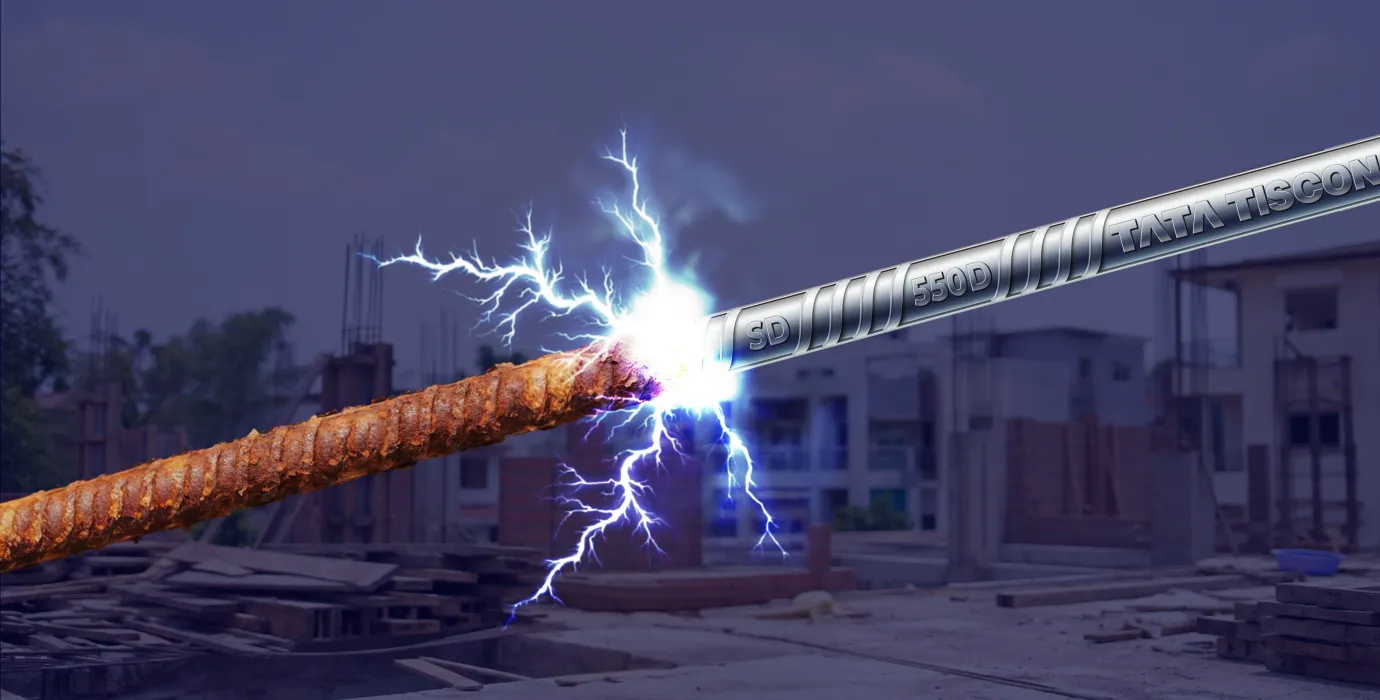
Builders and contractors often become concerned when they notice light rust marks on stored reinforcement bars at a construction site. In many cases, surface discoloration immediately raises questions about strength loss, durability, and whether the material is still safe for use.
The reality is that not all rust automatically damages reinforcement. Mild surface oxidation on properly manufactured TMT rebar is often manageable, while deeper corrosion and scaling can affect structural performance if ignored.
Understanding Rust on TMT Rebars
Steel naturally reacts with oxygen and moisture when exposed to humid or outdoor conditions. As a result, some level of surface oxidation can appear during transportation, storage, or prolonged exposure at construction sites.
However, not all visible rust indicates structural damage. In many cases, light surface rust forms only on the outer layer and does not penetrate deep enough to affect the core strength of the reinforcement.
The condition becomes a concern when corrosion progresses beyond the surface and begins reducing the effective cross-sectional area of the steel. This is where proper inspection becomes important before installation.
Common causes of TMT rebar corrosion include:
- Continuous exposure to moisture and rainwater
- Improper site storage without elevation or cover
- Contact with salts, chemicals, or coastal air
- Long storage duration without inspection
- Poor handling practices during transportation
Understanding the difference between superficial oxidation and severe corrosion helps avoid unnecessary material rejection and improves reinforcement management on-site.
Does Rust Weaken Steel Reinforcement?
One of the most common construction myths is that every sign of rust automatically weakens reinforcement steel. In reality, the impact depends on the intensity and depth of corrosion.
Light surface rust generally does not reduce the structural performance of properly manufactured TMT rebar. In fact, mild oxidation can sometimes improve bonding between concrete and steel by slightly increasing surface roughness.
However, deeper corrosion can become harmful when:
- Flaking or scaling appears on the surface
- Visible pitting reduces bar diameter
- The steel loses measurable cross-section
- Corrosion affects rib patterns and surface profile
- Structural cracks appear due to internal expansion
This distinction is important while evaluating stored reinforcement at construction sites. Engineers and contractors usually assess whether the rust is superficial or structurally damaging before deciding on replacement.
The question is not simply whether rust weakens steel reinforcement, but rather how severe the corrosion has become and whether the bar’s structural integrity remains intact.
Is Mild Rust on TMT Rebars Acceptable?
In many practical construction scenarios, the answer is yes. Mild and uniform surface rust is generally considered acceptable if the reinforcement still maintains its original dimensions, rib structure, and mechanical properties.
This is why construction professionals often inspect:
- Surface condition of the bar
- Presence of deep pits or scaling
- Uniformity of corrosion
- Loss of diameter or deformation
- Storage history and exposure conditions
If the rust can be removed through light wire brushing without leaving visible damage, the reinforcement is usually considered usable after proper inspection.
The issue becomes more serious when corrosion is uneven, flaky, or deeply penetrated. Such conditions may indicate advanced TMT rebar corrosion, which can compromise both load-bearing capacity and long-term durability.
This is especially important in coastal regions, humid environments, and projects exposed to repeated moisture cycles.
Preventing TMT Rebar Corrosion on Construction Sites
Proper handling and storage practices play a major role in reducing corrosion risks before reinforcement is embedded in concrete.
Important preventive measures include:
- Storing bars above ground level using supports or wooden blocks
- Covering reinforcement with waterproof sheets during rain exposure
- Avoiding direct contact with stagnant water or mud
- Separating old and newly delivered reinforcement stock
- Conducting periodic visual inspection before installation
Construction timelines also matter. Even high-quality TMT rebar can develop excessive corrosion if left exposed for extended periods without protection.
Many contractors now prioritise organised procurement and controlled inventory management while sourcing reinforcement materials. This has also encouraged the use of organised and digital procurement systems, including TMT rebar online sourcing channels, for better inventory tracking and supply planning.
How Manufacturing Quality Influences Corrosion Resistance
The corrosion performance of reinforcement also depends heavily on manufacturing quality, chemical composition, and process consistency.
High-quality 550 SD TMT rebars are typically engineered with improved strength and ductility while maintaining controlled manufacturing standards that support better structural reliability under demanding conditions.
Products like Tata Tiscon 550SD are manufactured with process-controlled production systems designed to maintain consistent reinforcement properties under varying construction conditions. Builders and contractors evaluating reinforcement options often compare technical specifications, supplier consistency, corrosion resistance, and practical procurement considerations before finalising material selection. In many projects, factors such as Tata Tiscon 550 SD price and long-term durability expectations are also evaluated alongside reinforcement performance.
In larger projects, developers may also review details such as 550 SD TMT rebars manufacturer standards and procurement channels when planning material sourcing. Today, many organised construction projects also prefer to buy 550 SD TMT rebars through verified supply networks for improved material traceability and quality assurance.
Identifying When Reinforcement Needs Replacement
Not every rusted bar requires rejection, but some warning signs should never be ignored.
Reinforcement replacement should be considered when:
- Heavy scaling or flaking is visible
- Deep corrosion pits affect surface integrity
- Bar diameter shows measurable reduction
- Rib patterns become damaged or unclear
- Structural deformation is observed
A proper technical inspection helps determine whether cleaning is sufficient or whether the reinforcement should be replaced entirely. Technical evaluation helps distinguish between manageable surface oxidation and structurally harmful corrosion.
Making Reinforcement Decisions More Practical
Visible surface rust does not always mean your TMT rebar is ruined. In many situations, mild oxidation is manageable and does not significantly affect structural performance when the reinforcement remains dimensionally and mechanically sound.
The real concern is uncontrolled TMT rebar corrosion that progresses deep enough to reduce strength, damage rib patterns, or affect long-term durability. Proper inspection, storage practices, and quality-controlled reinforcement selection all play a major role in maintaining structural reliability. Understanding the difference between superficial rust and damaging corrosion helps contractors, engineers, and homeowners make more informed reinforcement decisions during construction.