

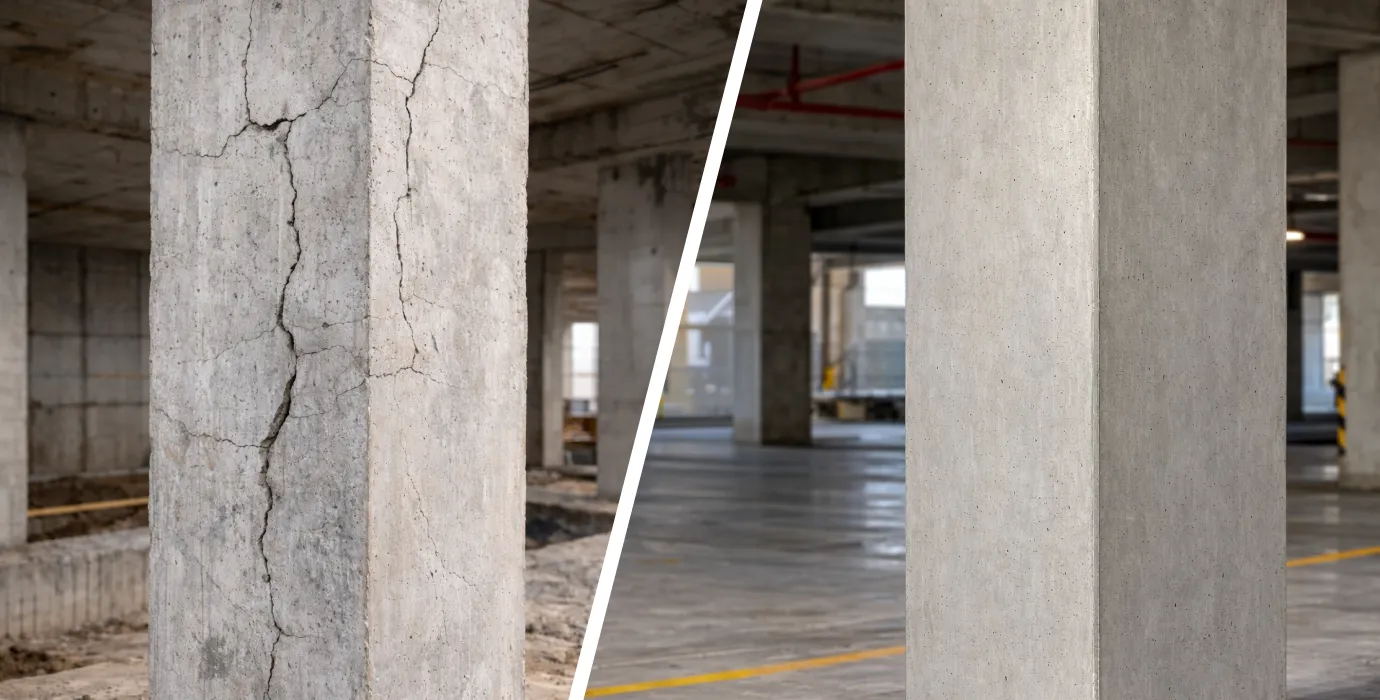
In commercial construction, reinforced cement concrete (RCC) columns are vital load bearing elements that transfer loads to the foundation. Early cracks in these columns can signify stress, construction errors, or reinforcement detailing issues. Proper commercial building column reinforcement is crucial for maintaining structural reliability, especially in projects with high loads.
Why Early Column Cracks Occur in RCC Structures
Cracks in RCC columns may occur as early as the initial phases of construction. The cracks may happen because of excessive loss of moisture, improper construction practices or excessive loading of columns before concrete achieves its strength.
Common causes of early column cracks include:
- Plastic shrinkage and curing issues, where rapid evaporation of moisture results in surface cracks due to insufficient curing.
- Poor concrete mix or compaction, which can create honeycombing in the concrete.
- Overloading of the structure, in which heavy loads are applied to a column before it’s strong enough.
- Settlement of foundation, where uneven settlement of foundation causes extra stress on the column.
- Inadequate steel placement, meaning the concrete cover is inadequate, leading to corrosion of steel.
These problems show why RCC column crack prevention must start during the design and reinforcement stage rather than after cracks appear.
Importance of Proper Reinforcement Detailing in Columns
Concrete has high compressive strength but low tensile strength, which is enhanced using reinforcement like steel bars. This composite material increases load-bearing capacity and improves structural stability under different loads.
Effective reinforcement detailing involves several important factors such as the size, spacing, and placement of bars, as well as sufficient clear cover to protect the steel from moisture and corrosion. Proper detailing of shear reinforcement for columns and column load transfer reinforcement ensures that the forces are safely transferred from the slabs and beams into the foundation.
Spacing of ties is another design parameter that must be carefully considered. For example, the stirrup spacing for RCC columns must be carefully controlled so that the buckling of longitudinal bars is avoided. The ties or the stirrups are typically provided at a spacing of 150-300 mm.
The Role of Confinement and Crack Control Reinforcement
The columns experience compressive stress in addition to bending and shear stress. To ensure stability, the column confinement reinforcement system is used. This involves the use of transverse ties or stirrups that hold the vertical bars together.
This reinforcement has the following functions:
- Prevents the buckling of longitudinal reinforcement bars
- Provides shear reinforcement for columns to resist diagonal tension
- Improves crack resistance and durability
- Ensures stability under heavy loads
This crack control reinforcement system is significant in commercial buildings since columns are used to hold heavy loads from different floors.
Superlink Reinforcement Systems for RCC Columns
Modern construction increasingly uses prefabricated systems for enhanced uniformity and efficiency, such as the Superlink reinforcement system. Superlinks utilize machine-made closed-loop stirrups, improving confinement and anchorage, and ensuring better stress distribution and uniform load transfer.
Some of the major advantages of using Superlink reinforcement are:
- Improved confinement of the concrete core
- Improved resistance against shear forces and buckling of the reinforcement bars
- Accurate dimensions because of machine manufacturing
- Reduction in labour required for installation and faster installation time
- Improved durability and long-term performance of the structure
Ready-for-use Superlinks help in the reduction of congestion in the reinforcement and in the compression of the concrete in the column reinforcement area.
Cost-Effective Reinforcement Solutions for Commercial Projects
Builders and contractors usually face the problem of balancing performance against cost. However, by opting for a cost-effective Superlink solution, it’s possible to improve the overall quality of construction while reducing labor time and waste.
It is crucial to work with a reliable Superlink manufacturer and Superlink supplier India. While it’s important to search for the Superlink price today, considering the long-term performance of the solution is likewise important. Right reinforcement detailing, along with solutions like Superlink, can benefit in effective RCC column crack prevention in commercial buildings.
Ensuring Column Durability in Modern Commercial Buildings
Reinforcement detailing is crucial for strengthening RCC columns, with advancements such as Tata Tiscon Superlinks significantly improving crack prevention in commercial structures. These technologies assist engineers in achieving better confinement, load transfer, and enhancing the overall durability of RCC columns. Consequently, this results in the creation of more robust structures for commercial developments in India.